Organising a small vanity when there is no more surface

A vanity fails at the point where the third layer goes down. Once things are stacked on things, nothing is findable and the surface stops working. The fixes are ordered: go vertical, then move things off the surface entirely, then reduce.
Vertical first, because it is free space
A tiered unit occupies the same footprint as a flat tray and holds two or three times as much, and everything on it remains visible. On a small surface that is the highest-return change available.
The constraint is clearance height above the surface, which is why that measurement matters so much on a small vanity specifically.
Rotating units use the awkward corner
A 360-degree rotating organizer makes the back of a deep unit reachable, which turns dead space into usable space. Corners and deep surfaces are where things go to be forgotten.
They need clearance all round to spin, so measure the width rather than the depth. A rotating unit against a wall on one side is just a fixed unit.
Move the overflow off the surface
A rolling cart parked beside or under the vanity holds everything that is not used daily, and it moves out of the way when you need the floor. This is the single most effective intervention for a genuinely small setup.
The daily items stay on the surface, everything else lives on the cart, and the surface becomes usable again without discarding anything.
Separate daily from occasional, honestly
Most people keep everything within arms reach and use perhaps a fifth of it daily. Physically separating the two is what makes a small space work, and the separation has to be honest rather than aspirational.
A useful test: put anything you have not used in a month into a box for a month. What you go and fetch belongs on the surface; what you do not go and fetch does not.
Group by use, not by type
Storing all bottles together and all tubes together looks tidy and works badly, because a routine uses several types in sequence. Grouping by when things are used means one container comes out rather than four.
This is why divided cases with mixed compartment sizes are more useful than uniform ones for a small setup.
Drawer units under, display over
Closed drawers at the bottom, visible storage at the top. It keeps the visible layer small, which keeps it tidy, and it puts the dust-sensitive items where they are protected.
It also means the thing you see when you walk into the room is the small tidy layer rather than everything you own.
Decanting and backstock
Backups do not belong on a vanity. They belong somewhere cool, dark and out of the way, with only the open item in circulation. This alone frequently halves what is on the surface.
A single labelled box elsewhere in the house is sufficient. It does not need to be attractive because it is not on display.
The wall is available
Where the surface is genuinely full and a cart will not fit, a shelf above the vanity moves the overflow up. This is a different kind of project and it is worth considering before buying more surface-level storage.
Keep anything on a wall shelf light and closed, because dust falls and shelves above a working area collect it.
Reduce, eventually
Storage cannot solve a volume problem indefinitely, and at some point the honest answer is that there is more than the space can hold. Nothing in this catalogue changes that, and it would be dishonest to suggest otherwise.
Expired products are the easiest place to start and usually account for more than people expect. After that it is a matter of preference rather than organisation.
Making the system survive a busy week
A system with too many steps is abandoned within a fortnight. If putting something away takes more than one movement, it will end up on the surface instead, and the surface will fill again.
Open trays and single-motion storage beat anything requiring a lid to be lifted and a compartment to be found, for the daily layer specifically.
Space-saving pieces
- HapiRm Rolling Makeup Cart Organizer – White Under Desk Storage with 3 Drawers — $45.99
- AERCIINC Large Makeup Organizer with Brush Holder & Drawers, Beige — $29.98
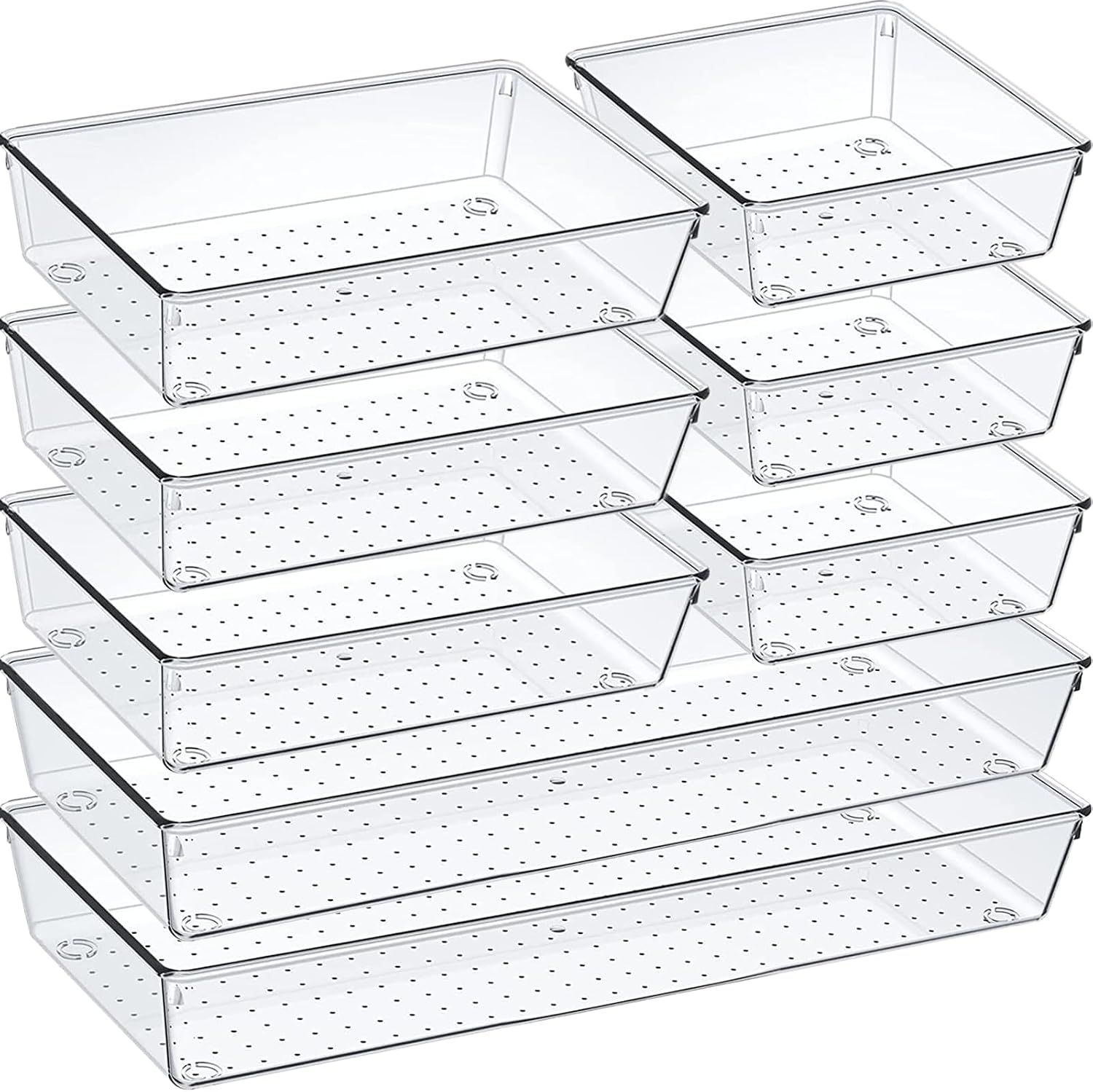
- Criusia 8-Pack Clear Acrylic Drawer Organizer Set with Non-Slip Pads — $22.99
- Vtopmart 3-Tier Skincare Organizer with Drawers & Dustproof Lid, White — $21.99
See everything in Cosmetic Organizers.
Where to start
Go vertical with a tiered or rotating unit, move everything non-daily onto a cart, keep backstock out of the room entirely, and make putting things away a one-movement job. Reduce only once those four are done.
Questions about anything above? Our FAQ covers the usual ones, the Shipping Policy has the delivery detail, and you can contact us directly — we answer within one business day.